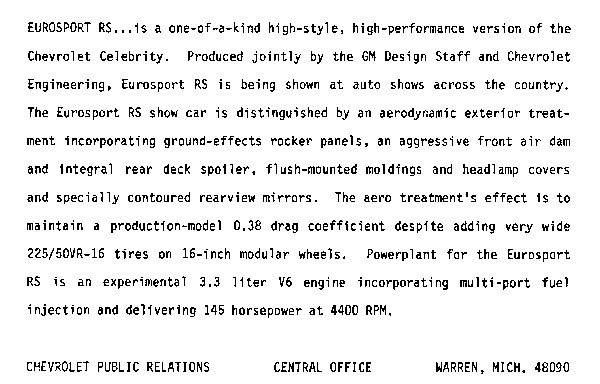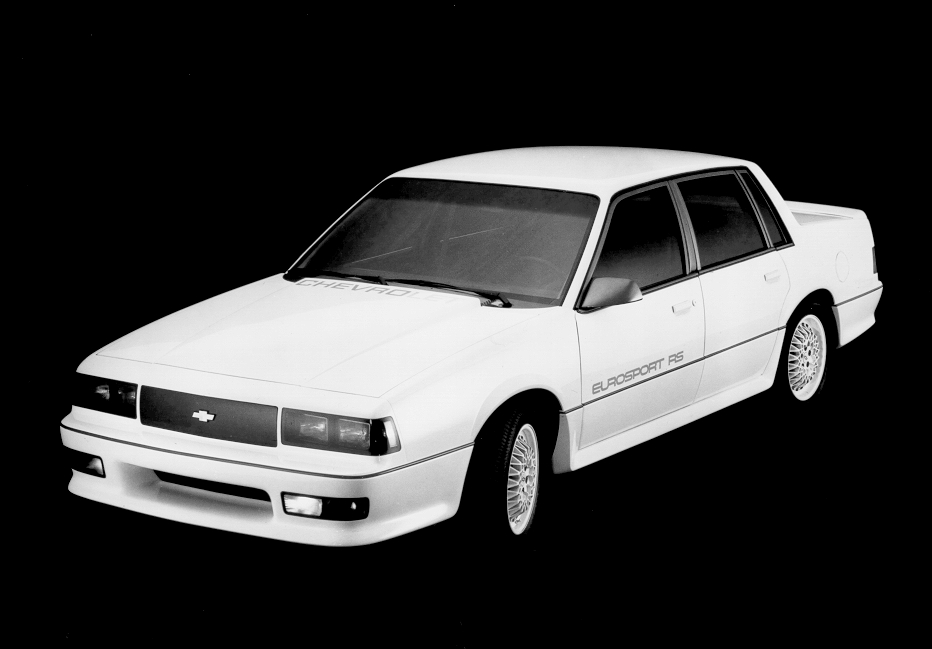
The Chevrolet Eurosport VR began life as the Celebrity RS concept car in 1986. The RS had an all-aluminum V6 engine, a custom interior, ground effects and special wheels. It was a big hit on the auto show circuit and GM wanted to capitalize on the enthusiasm for the car and get a street version on the market quickly. This is where Jim Luikens and AutoStyle Cars came into the picture. Jim, who already had a long history in the muscle car era with Berger Chevrolet, was working with AutoStyle, a company that manufactured OEM components for the auto industry and did some semi-custom work for them as well. As a side note, Jim and AutoStyle were also involved with the prototype for the first generation Chevrolet S-10 Extreme truck and got the job of bringing the production RS to market.
Somewhere along the line, GM decided to change the name of the car to Eurosport VR. The first VR speed-rated tires had just hit the market and possibly GM thought that was a pretty catchy designation. So the RS was renamed Eurosport VR. The VR looked the part, but it was "all show and no go" by the time it went into production. The show car’s all-aluminum V6 was dropped due to time and expense constraints.
All of the VRs were built at the Oklahoma City GM plant, right alongside their sister A-body cars. At the time Oklahoma City was GM’s number one plant for quality. For 1987 there were 4-door sedan and wagon VRs with a 2-door coupe added in 1988. The actual VR conversion was done less than one mile from the GM plant in a nearby building that AutoStyle had leased expressly for that purpose. GM specified that for the program to work the cars could be driven no more than 1 mile each way to and from the plant. Specific Eurosport Celebritys were pulled from the OKC assembly line and then driven down the street for the VR conversion and back to the plant for ultimate delivery through the GM system.
In the 1987 model year the VR’s interior was completely replaced with custom seats, door panels, a cup holder extension on the back of the console and blood red acoustic carpet. Eurosport VR side graphics and a Chevrolet logo on the hood were stock. The factory aluminum wheels had painted accents panels added that were the same color as the body. This procedure proved to be too costly and was dropped for the 1988 model year.
GM had an “unwritten” formula that said a single option for a car should not exceed 10% of the base price of the car. In 1987, the VR option, a package consisting of several upgrades, was more than 10% of the base price of the car. In fact, it was nearly $4000 dollars while the base price of the Celebrity Eurosport in 1987 was around $13,000. Including other options the VRs sold for more than $17,000. Looking for a way to cut the option price for 1988 the custom interior and painted-accent wheels were deleted. In 1988 VRs had the stock Celebrity interior and the wheels had a sticker on part of them instead of the painted accents. This cut the cost of the option by more than half.
The VRs came in various option levels. You would think that being a VR, it would have had all of the options. This was not the case. Some had no power windows, locks or even A/C. Others were fully loaded, even with a sunroof. This was true in both model years. There were a few 5-speed VRs made, but 98% had automatics. No manual trans VR wagons were ever manufactured. There was only one 2-door 5-speed built, a 1988 model. It had a German Getrag manual transmission. That is car that you see on this site. There were other orders for them, but GM was having trouble keeping up with demand for that particular transmission at the time. (UPDATE: 11/22/07 There are now 3 confirmed 2-door 5 speed VRs.)
The VR was available in black, white, silver or a special Code 81 red from the Camaro and Corvette. Code 81 red was a non-stock color for an A-body car and no other A-bodies were ever painted this shade of red. There were two custom paint lines at the Oklahoma City plant. During 1987 and 1988 one of the two special lines was set up exclusively to paint this red. The other special paint line was reserved for any other special painting that was needed for corporate or fleet vehicles. This was done because red is such an expensive color it cost too much to clear the lines of any unused paint before switching colors. So one line sprayed nothing but red paint until they had all of the red cars they needed.
The Eurosport VR is Chevrolet’s lowest production specialty car built to date. There was a total of approximately 1500-1700 of them built during their 2 year run. There are no firm production numbers available although approximately 700-800 of them were built each year.(NOTE: Production numbers for 1987 were 1021(verifiable) and approx. 600 for 1988(not verified)) The exterior of the cars did not change between years, except for the wheel accents, and the 2.8 V6 engine was the only engine offered.
Some of the VRs were marketed through the Amway Corporation. Yes, the soap
people. You could order a VR through Amway. And get apparel too. A VR sweat
suit, t-shirts and other things were among the unique items offered.